In the 1070s CE, the Bayeux Tapestry, handcrafted in England, went to Normandy. The Tapestry’s return in 2026 generated much controversy and reawakened debate about changing its name and designation from a tapestry to an embroidery. It also sparked memories of my early days in the 1990s when I first began researching my novels. An English historian I’d met told me that the Bayeux Tapestry was an essential reference. At the time, I didn’t know what it was.
What Is the Bayeux Tapestry?
I soon discovered that the Bayeux Tapestry is a strip of embroidered linen, 240 feet long, about 20 inches high. This nearly 1000-year-old graphic novel of its time tells the story of William the Bastard, the duke of Normandy, who defeated the English king, Harold Godwinson, at the Battle of Hastings in 1066.
The 58 numbered scenes and Latin captions function like chapters, allowing anyone, especially those who cannot read, to learn why the French-speaking Normans went to England. Within a decade of the great battle, people who had actually lived through the events created this commemorative record.
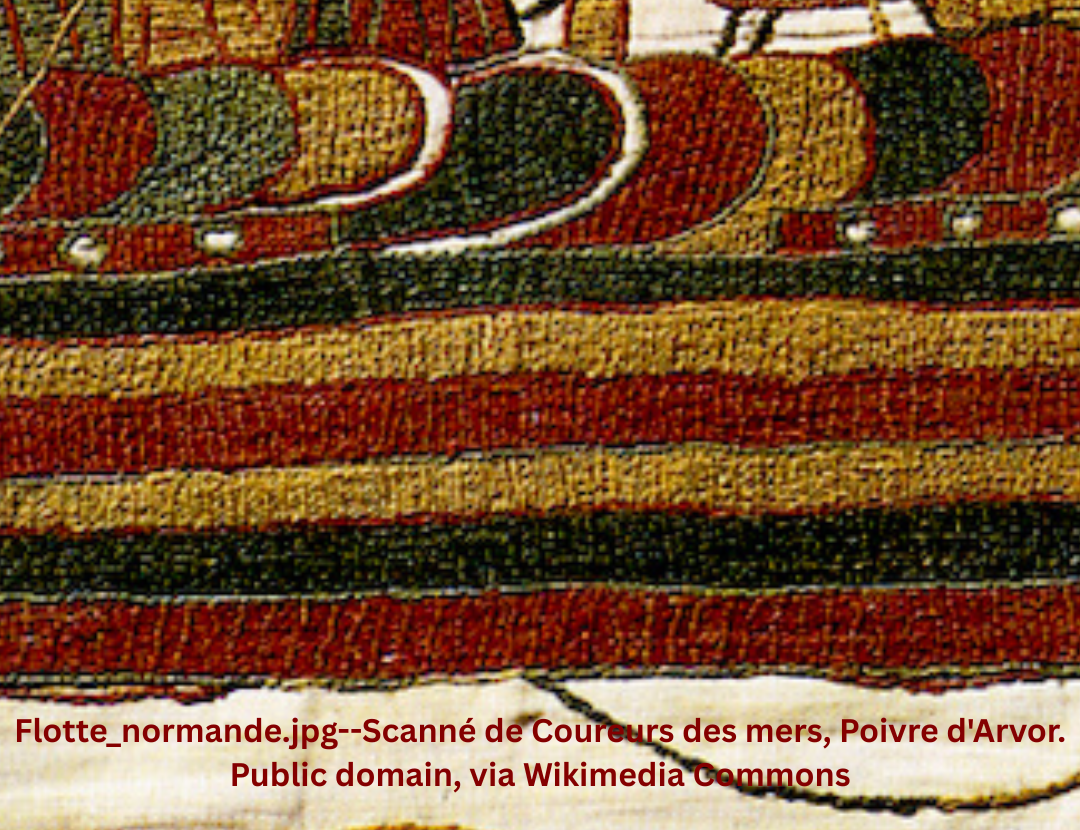
Although the linen is slightly discolored, the dyed woolen threads glow in vibrant colors: rich russets, scarlet reds, lapis blues, vine greens, sunflower yellows, and soft, dusty browns. Embroidered figures stand beside outlined forms not yet filled, as if the piece is suspended in time awaiting another stitch.
What Does the Bayeux Tapestry Depict?
The Tapestry is an iconic emblem of the medieval period from which it emerged, an easily recognizable symbol of this momentous historical moment, and a snapshot of life lived a millennium ago. That’s why its images grace my website and the cover of my novel Knight’s Pawn, the first book in my saga about the Norman Invasion of England.
As it’s the most consistent contemporary record of the details enhancing my tale, I frequently visit the official site for the Bayeux Tapestry in Normandy, France. Despite the static, cartoonish images, the scenes are surprisingly animated: wind blows a warrior’s hair, unfurls battle pennons, and fills sails. Dragonhead ships bob on the water, horses leap onto the shore.
Hunting dogs wear collars with rings for the leash. Some men don knee-length trousers, others knee-length tunics with decorative hems. They pin their cloaks with brooches over their right shoulders, and take off their hose and shoes and raise their tunics when wading to and from their ships.
The English have full heads of hair, beards, and mustaches. The clean-shaven Normans have partially-shaved heads. We see Normans constructing their longships and loading their armor and supplies. They use their elongated shields as dining tables and raise them over their heads when entering water.
The Tapestry is a treasure trove of architecture and military history. We see lavish cathedrals and castles, flaming huts, and timber forts rising from dirt and rock. Warriors do not buckle on their swords; they tie them around their waists. The English fight on foot using round shields and wielding lethal axes, slings, and rocks. Norman archers batter the English. Their foot soldiers attack with spears and swords. Cavalrymen gallop their stallions into the English shield wall.
Mysteries & Drama of the Bayeux Tapestry
Throughout the Tapestry, mysteries abound. Who is overseeing the trek from Mont-Saint-Michel? He is not a churchman, Norman, or Saxon. He holds a staff with a dragon head, which indicates his formidable judicial powers. God? The Tapestry’s designer? A master embroiderer overseeing the workers?
Who is the enigmatic woman bearing the Anglo-Saxon name Ælfgyva beside the unnamed ecclesiastic? The Oxford Foundation for Medieval Genealogy provides a fascinating discussion of this scene. The striped columns, like brackets, indicate an important moment. The gestures could mean an animated discussion, anger, a slap, or a caress implying sexual privilege. The latter possibility is enforced by the lower border, where a naked man displaying his genitals mirrors the priest’s stance.
Why did the embroiderers include nudes running toward each other, arms outstretched? Are the trees and mythical creatures coded messages to undermine the Norman version of this story?
I think of the Tapestry as a play, with actors on the main center stage and a Greek Chorus represented by the narrow top and bottom trim or friezes. The upper decorative border is filled with real and possibly symbolic creatures, and fables offering moral judgments. The lower border shows day-to-day occurrences: tilling, sowing, hunting, or a battlefield strewn with writhing bodies.
I can almost hear the harmony: the high tones of the upper border, the drumbeat of daily life in the lower border, the unstoppable history moving in the center, the horses, the clash of swords, the screams of warriors, and the moans of millions.
Well, I’m an author. I have an active imagination.
Why was the Bayeux Tapestry Made: History or Propaganda?
The Bayeux Tapestry has been called an accurate historical record—or a great piece of 1000-year-old propaganda.
Though often labeled as depicting the Norman Conquest, the Tapestry does not recount the years after the Battle of Hastings, when the English nearly took back their land and killed more than a thousand Norman soldiers, nearly a quarter of the occupying force. Nor does it depict William the Conqueror’s brutality, which massacred or starved 100,000 people, or the shifts in land and wealth, law, language, and culture that followed.
Who Made the Bayeux Tapestry? Origin vs. Accuracy
I’m a novelist, not an historian. Nevertheless, when writing about the past, I strive to give my readers an exciting journey without polluting the history with anachronistic concepts or language. I don’t always succeed, as some concessions are necessary to keep modern readers engaged. I don’t write in Old English, for example. Thus, it surprises me when historians want to apply anachronistic terminology to this unique artifact and rename it the Canterbury Embroidery.
Most scholars agree that the Tapestry was likely commissioned by Odo, Bishop of Bayeux, William the Conqueror’s half-brother and Earl of Kent. Perhaps he wanted to display it at his new cathedral in Bayeux, Normandy.
The project was planned, designed, and supervised by a Norman cleric or prelate and executed in Canterbury, a village in Kent. It is likely that the embroiderers included Anglo-Saxon women, famed across Europe for their needlework.
In the 11th century, the Norman cleric who oversaw this work spoke what today we call Old French. In his language, the word for “tapestry” was tapisserie, from Medieval Latin tapetum and Greek tapēs, meaning covering. The word meant heavily decorated fabric or wall coverings, including pictorial scenes or ornamental designs, embroidered, painted, or woven.
Five hundred years later, the word “tapestry” became a narrowly defined term, referring only to weft-faced woven textiles, after weavers began using looms and some form of mechanization to produce large-scale wall hangings.
I hope the name of the Bayeux Tapestry remains to preserve the language spoken by the skilled artisans at the historical time of its creation. Language matters. It is important to our collective understanding of our past, and is as important to protect as repairing the embroidery with natural rather than synthetic dyes, by hand rather than machines.
See it in Person at the British Museum in England
The Bayeux Tapestry by any other name is a masterpiece that says much about human tenacity and storytelling. If you can travel, see it in person.
The Bayeux Tapestry will be in London at the British Museum from September 2026 until July 2027. Afterward, it will return to the Bayeux Museum in France.